Which Is Better: LCD or LED Car Display?
Which Is Better: LCD or LED Car Display?
When choosing a display for a vehicle, buyers often ask: Which is better, an LCD or LED car display? The answer depends on what you mean by “LED display” and how the screen will be used.
In most modern vehicles, the screens commonly called LED car displays are actually LCD panels with LED backlighting. True direct-view LED displays are much more common in large outdoor signs and commercial advertising screens than in dashboards, head units, rear-seat monitors, or bus displays.
For most automotive applications, a high-quality TFT LCD with LED backlight is usually the more practical choice.
What Is an LCD Car Display?
An LCD car display uses liquid crystal technology to create images. The LCD panel itself does not produce light, so it needs a backlight.
Modern automotive LCD screens normally use LED backlighting because LEDs provide good brightness, low power consumption, compact size, and long service life.
That means many displays marketed as “LED car screens” are technically LCD displays using LED backlights.
LCD technology is widely used in:
Car infotainment systems
Center control displays
Rear-seat entertainment monitors
Bus and coach monitors
Electronic rearview mirrors
Parking and reversing displays
Vehicle instrument panels
For automotive applications, TFT LCD remains one of the most common display technologies because it offers a good balance between image quality, cost, durability, and customization.
What Is an LED Car Display?
A true LED display uses light-emitting diodes as the actual pixels that create the image.
This technology is commonly found in:
Large advertising displays
Outdoor vehicle signs
Destination boards
Commercial information displays
Large-format digital signage
Direct-view LED displays can achieve very high brightness and are excellent for long viewing distances. However, they are generally not ideal for small automotive screens because the pixel structure is larger and the cost can be higher.
For a 7-inch, 10.1-inch, 15.6-inch, or 21.5-inch vehicle monitor, TFT LCD technology is usually more suitable.
Image Quality
For close-range viewing inside a vehicle, LCD usually provides better image detail.
A modern TFT LCD car display can offer resolutions such as:
1280 × 720
1280 × 800
1920 × 1080
1920 × 1200
These resolutions provide sharp text, detailed video, navigation information, and camera images.
True LED displays are more suitable for larger screens viewed from farther away. For dashboards or passenger monitors, an LCD panel generally provides finer pixel density.
Therefore, for car monitors, bus LCD monitors, and center control screens, LCD usually has the advantage.
Brightness
Brightness is especially important inside vehicles because sunlight can make a display difficult to read.
Standard LCD displays may offer around 300–500 cd/m² brightness, while high-brightness automotive LCD displays can reach:
700 cd/m²
1000 cd/m²
1200 cd/m²
1500 cd/m² or higher
Because modern LCD panels use LED backlights, brightness can be increased significantly while keeping the display relatively thin.
A high-brightness TFT LCD is therefore suitable for vehicles exposed to strong daylight.
Direct LED displays can reach even higher brightness, but this level is normally unnecessary for an interior automotive monitor.
Power Consumption
Vehicle electronics must operate within a limited power system.
LCD panels with LED backlighting generally provide good energy efficiency, making them suitable for long operating periods.
This is particularly important for:
Buses
Coaches
School buses
Commercial fleets
Construction vehicles
Passenger vehicles
A display that consumes less power can reduce the load on the vehicle electrical system.
Screen Thickness
Automotive displays often need to fit into restricted installation spaces.
TFT LCD screens can be manufactured in relatively thin structures, making them suitable for:
Dashboard integration
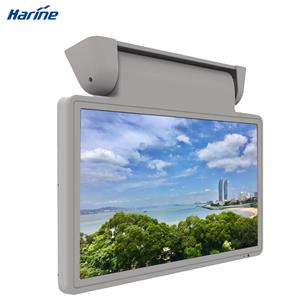
Roof-mounted monitors
Manual-flip monitors
Motorized flip monitors
Seat-back monitors
Center consoles
This flexibility makes LCD technology especially useful for customized vehicle display projects.
Viewing Angle
Viewing angle is another important factor.
Inside a bus or coach, passengers may view the monitor from different seating positions.
Modern IPS TFT LCD technology can provide wide viewing angles, often around 178 degrees, helping maintain consistent image quality from different directions.
This makes IPS LCD particularly suitable for passenger information and entertainment displays.
Cost
For small and medium-sized automotive displays, LCD is generally more cost-effective.
A true direct-view LED screen with similar dimensions and resolution can be considerably more expensive.
For OEM vehicle projects involving hundreds or thousands of displays, cost differences can become significant.
This is why TFT LCD remains widely used by vehicle manufacturers and system integrators.
Durability
Vehicle displays must operate in environments that may include vibration, temperature changes, dust, and extended operating hours.
Automotive and industrial TFT LCD displays can be designed with:
Wide operating temperature ranges
High-brightness backlights
Metal housings
Anti-glare surfaces
Vibration-resistant structures
Customized mounting brackets
For commercial vehicle projects, these features can be more important than simply choosing between LCD and LED terminology.
LCD vs LED Car Display Comparison
| Feature | TFT LCD with LED Backlight | Direct LED Display |
|---|---|---|
| Image detail | Excellent | Better for large viewing distances |
| Small screen applications | Excellent | Less suitable |
| Automotive integration | Excellent | Limited |
| Brightness | High to very high | Extremely high |
| Power consumption | Relatively low | Depends on size |
| Thin design | Excellent | Usually thicker |
| Cost | More economical | Usually higher |
| Best applications | Car monitors, dashboards, bus monitors | Large signs and advertising displays |
Which Is Better for a Car?
For most vehicle applications, TFT LCD with LED backlighting is the better choice.
It offers high resolution, good brightness, compact dimensions, relatively low power consumption, and competitive pricing.
If the application involves:
Navigation
Rear-seat entertainment
Parking cameras
Bus passenger information
Coach entertainment
Center control systems
Electronic rearview mirrors
then an LCD-based display is normally more practical.
A direct-view LED display becomes more attractive when the screen is very large, needs extremely high brightness, or must be viewed from a long distance.
What Should Buyers Look for in an Automotive LCD Display?
Instead of focusing only on whether a display is called LCD or LED, B2B buyers should pay attention to the actual specifications.
Important factors include:
Screen size: Select the appropriate dimensions for the vehicle installation.
Resolution: Higher resolution provides sharper text and images.
Brightness: High-brightness screens are useful in strong ambient light.
Viewing angle: IPS panels are particularly useful for passenger applications.
Interfaces: HDMI, AV, VGA, USB, LVDS, and other interfaces may be required depending on the system.
Operating temperature: Commercial and industrial vehicles may require wide-temperature displays.
Mounting structure: Fixed, manual-flip, motorized, roof-mounted, and embedded designs can be selected according to the application.
Customization: OEM projects may require customized housings, cables, logos, interfaces, or mounting brackets.
FAQ
Are LED car displays better than LCD displays?
Not necessarily. Most modern automotive LCD displays already use LED backlighting. For small and medium-sized vehicle screens, TFT LCD usually provides better resolution, integration flexibility, and cost efficiency.
Is an LCD display suitable for a bus?
Yes. LCD monitors are widely used in buses and coaches for passenger information, entertainment, advertising, camera monitoring, and safety information.
Which display is better in sunlight?
A high-brightness LCD display can perform very well in daylight. For strong sunlight environments, buyers should consider screens with higher brightness and anti-glare treatments.
What type of display is commonly used in modern cars?
TFT LCD displays, particularly IPS TFT LCD panels with LED backlighting, are widely used in modern automotive applications.
Can automotive LCD monitors be customized?
Yes. Depending on the project, screen size, brightness, housing, mounting structure, interface, cable, logo, and other specifications can often be customized.