Why Do Bus LCD Monitors Need Anti-Vibration Design?
Why Do Bus LCD Monitors Need Anti-Vibration Design?
A bus LCD monitor operates in a much more demanding environment than a display installed in an office, store, or home.
During daily operation, buses and coaches are continuously exposed to road vibration, sudden impacts, braking, acceleration, and changes in road conditions. Even small vibrations can be transmitted through the vehicle body to the monitor, mounting bracket, internal circuit board, connectors, and LCD panel.
For this reason, a reliable bus LCD monitor should not simply provide a clear image. Its mechanical structure and electronic components should also be designed to withstand continuous vibration during long-term vehicle operation.
Anti-vibration design is therefore one of the key differences between ordinary commercial displays and monitors developed specifically for buses and coaches.
Why Is Vibration a Problem for Bus LCD Monitors?
Vehicle vibration may appear minor during a short trip, but commercial buses can operate for many hours every day.
Over months or years, repeated vibration can place continuous mechanical stress on the monitor.
Connections may gradually loosen, internal components may shift, mounting structures may become unstable, and cables or connectors may experience repeated movement.
In severe cases, vibration can lead to intermittent signal problems, screen flickering, abnormal noise, or complete display failure.
This means vibration resistance is not only related to physical durability. It also directly affects image stability and the long-term reliability of the entire onboard display system.
Road Conditions Create Continuous Mechanical Stress
A bus monitor may be installed on the ceiling, side wall, dashboard, or other parts of the vehicle interior.
Regardless of installation position, vibration from the road is continuously transferred through the vehicle structure.
Urban buses frequently experience braking, acceleration, speed bumps, potholes, and uneven road surfaces.
Long-distance coaches may travel for many hours at highway speeds, creating constant low-frequency vibration.
Shuttle buses and tourism vehicles may operate on roads with significantly different surface conditions.
For a coach LCD monitor, these repeated vibrations mean that the display structure must remain secure throughout thousands of operating hours.
Anti-Vibration Design Protects the LCD Panel
The LCD panel is one of the most important and delicate parts of a bus display.
Although modern TFT LCD panels are relatively durable, repeated mechanical stress can still affect the panel if the housing does not provide sufficient structural support.
A vibration-resistant monitor typically uses a stronger internal frame and housing structure to keep the LCD panel securely positioned.
Proper support helps distribute vibration rather than allowing excessive movement to concentrate on one part of the screen.
This is particularly important for larger displays such as 18.5-inch or 21.5-inch bus monitors because the larger panel surface can experience greater mechanical stress during vehicle movement.
Secure Mounting Is Equally Important
Anti-vibration performance does not depend only on the monitor itself.
The installation structure is also critical.
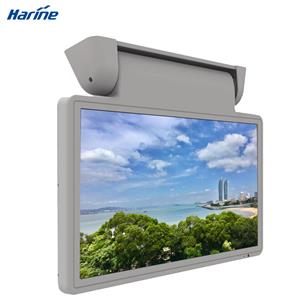
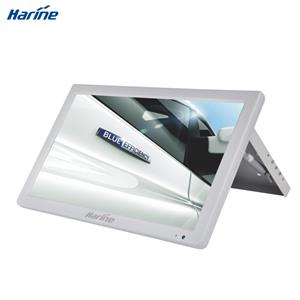
A fixed bus display screen may be installed using wall-mounted or roof-mounted brackets, while a flip-down monitor introduces additional moving components.
If the mounting system is not sufficiently rigid, vibration can cause the monitor to shake continuously during travel.
This can reduce viewing comfort for passengers and place additional stress on screws, brackets, hinges, and internal components.
For this reason, vehicle displays should use mounting structures designed for transportation environments rather than generic indoor display brackets.
Why Flip-Down Bus Monitors Need Extra Structural Stability
Flip-down monitors are commonly installed in coaches because they save interior space.
When not in use, the screen can be folded toward the ceiling. When passengers need entertainment or information, the display can be opened.
However, the hinge or motorized mechanism introduces additional mechanical parts.
These components must remain stable even when the vehicle is constantly vibrating.
For manual flip monitors, the hinge must maintain sufficient holding force over repeated opening and closing cycles.
For motorized flip monitors, the motor, gears, and support structure must remain aligned during vehicle movement.
A poorly designed mechanism may gradually become loose, noisy, or unstable.
This makes anti-vibration construction particularly important for roof-mounted flip-down bus monitors.
Connectors Can Be Affected by Long-Term Vibration
Signal and power connectors are another important area.
A bus LCD monitor may connect to media players, passenger information systems, cameras, or other onboard equipment using HDMI, VGA, RCA, DVI, or customized interfaces.
During daily driving, repeated vibration can place mechanical stress on these connectors.
If the connector fit is poor or the internal cable is not secured properly, contact resistance may increase or the signal may become intermittent.
This can cause symptoms such as temporary black screens, image flickering, signal loss, or unstable power.
A vibration-resistant design should therefore consider not only the LCD panel and housing but also cable routing, connector fixation, and internal PCB mounting.
PCB and Electronic Components Also Need Protection
Inside the monitor, electronic components are mounted on printed circuit boards.
Although these components are small, repeated vibration can still affect solder joints and connectors over long periods of operation.
Vehicle-grade monitor construction normally attempts to reduce unnecessary PCB movement and keep important components securely fixed.
This is especially important because buses generate both mechanical vibration and electrical interference.
A reliable monitor should therefore combine anti-vibration and anti-interference design to maintain stable operation in the vehicle environment.
Many dedicated bus LCD monitors are specifically designed with both characteristics because mechanical and electrical reliability are equally important for transportation applications.
Anti-Vibration Design Improves Passenger Viewing Experience
Vibration resistance is not only about preventing hardware failure.
It also affects how passengers experience the screen.
A monitor that visibly shakes while the bus is moving can make video content, route information, or advertising difficult to view.
This becomes particularly noticeable with ceiling-mounted displays because even small movements at the mounting point can produce larger visible movement at the screen.
A stable mounting system and rigid monitor structure help keep the image position more consistent during travel.
For passenger information displays and onboard entertainment systems, this creates a more professional and comfortable viewing experience.
Anti-Vibration Design Helps Extend Service Life
Commercial buses are normally operated much more intensively than private vehicles.
A fleet operator may expect onboard equipment to remain operational for several years.
Replacing monitors frequently increases not only hardware costs but also maintenance time and vehicle downtime.
Anti-vibration construction helps reduce mechanical wear and improves long-term stability.
The benefit is particularly important for operators managing large fleets, because even a relatively small failure rate can result in significant maintenance workload when hundreds of vehicles are involved.
For bus manufacturers and system integrators, using monitors developed for transportation environments can therefore reduce lifecycle maintenance risks.
Anti-Vibration and Wide-Voltage Design Work Together
Mechanical vibration is only one challenge inside a bus.
Vehicle electrical systems may also experience voltage fluctuations during engine start, alternator operation, battery charging, or switching of other electrical equipment.
For this reason, many professional bus monitors combine anti-vibration construction with a wide-voltage power supply.
For example, bus LCD monitors may support approximately DC 10.5–32V, allowing them to operate across common 12V and 24V vehicle electrical systems.
This combination provides protection against both mechanical and electrical instability.
A display designed only for indoor environments may not provide the same level of reliability under these conditions.
Where Are Anti-Vibration Bus LCD Monitors Used?
Anti-vibration monitors can be used in many commercial transportation applications.
In city buses, they may display passenger information, advertising, route content, or entertainment.
In long-distance coaches, they are frequently used for movies, tourism information, promotional content, and onboard entertainment.
Airport shuttle vehicles may use them to provide terminal information and service announcements.
Tour buses can display destination introductions and travel information.
Commercial fleets may also integrate vehicle LCD monitors with digital signage, multimedia players, or centralized passenger information systems.
In all of these applications, the monitor is expected to continue operating while the vehicle is moving.
Why Ordinary Indoor Monitors Are Not Ideal for Bus Applications
An ordinary commercial monitor may offer excellent image quality, but that does not automatically make it suitable for buses.
Indoor displays are usually installed in relatively stable environments.
They do not normally need to tolerate continuous vibration, vehicle power fluctuations, frequent acceleration, or constant movement.
The housing, mounting structure, connectors, and power design may therefore be optimized for stationary use rather than transportation.
A purpose-built bus LCD monitor considers these environmental differences from the beginning of product development.
This makes it better suited to long-term operation in coaches and commercial vehicles.
What Should Bus Manufacturers Pay Attention To?
For bus manufacturers, fleet operators, and system integrators, anti-vibration performance should be considered together with other technical specifications.
Screen size, resolution, installation method, power input, video interface, brightness, viewing angle, and operating temperature all affect whether the monitor is suitable for a particular vehicle.
For example, a 15.6-inch fixed monitor may be suitable for compact passenger information applications, while an 18.5-inch or 21.5-inch flip-down monitor may be more appropriate for coach entertainment systems.
The correct configuration depends on the vehicle interior and the intended application.
Conclusion
Bus LCD monitors are continuously exposed to vibration during vehicle operation, making anti-vibration design an important requirement for reliable performance.
A vibration-resistant structure helps protect the LCD panel, internal PCB, connectors, brackets, hinges, and motorized mechanisms from long-term mechanical stress.
It also helps maintain stable images and reduces the risk of loose connections, signal interruption, and premature component failure.
For buses, coaches, shuttle vehicles, and other commercial transportation systems, a monitor developed specifically for vehicle environments can provide better long-term reliability than an ordinary indoor display.
Harine provides fixed, manual flip, and motorized flip bus LCD monitors for passenger information, onboard entertainment, advertising, and other commercial vehicle applications, with anti-vibration, anti-interference, wide-voltage power input, and OEM/ODM customization options.